Monday, May 23, 2016

Rou Gui Oolong

Mount Wuyi in Fujian, China, is a UNESCO World Heritage site.   The Wuyi topography is a landscape of majestic mountains, characterized by rocks, sandstones and rivers.   Many oolong teas are cultivated in this area, and they are commonly referred to as 'rock' teas.   The four well-known ones are Big Red Robe,  Iron Arhat, White Cockscomb and Water Golden Turtle. The more popular and affordable ones include Rou Gui and Shui Xian (Narcissus Flower).   Due to the terroir, Wuyi teas are said to embody unique 'rock bone' essence.  That is, these oolongs could figuratively transport you to the beauty of the Wuyi mountains through your cup.

Rou Gui is cinnamon or cassia bark in Chinese.   The Rou Gui cultivar is one of the many tea bush varieties in Wuyi.  This oolong is about 40% oxidized and medium-fired.   It is a comforting and warming tea.

Rou Gui

Type:  Oolong   Producing Country: China    Preparation:  95°C 4 Min

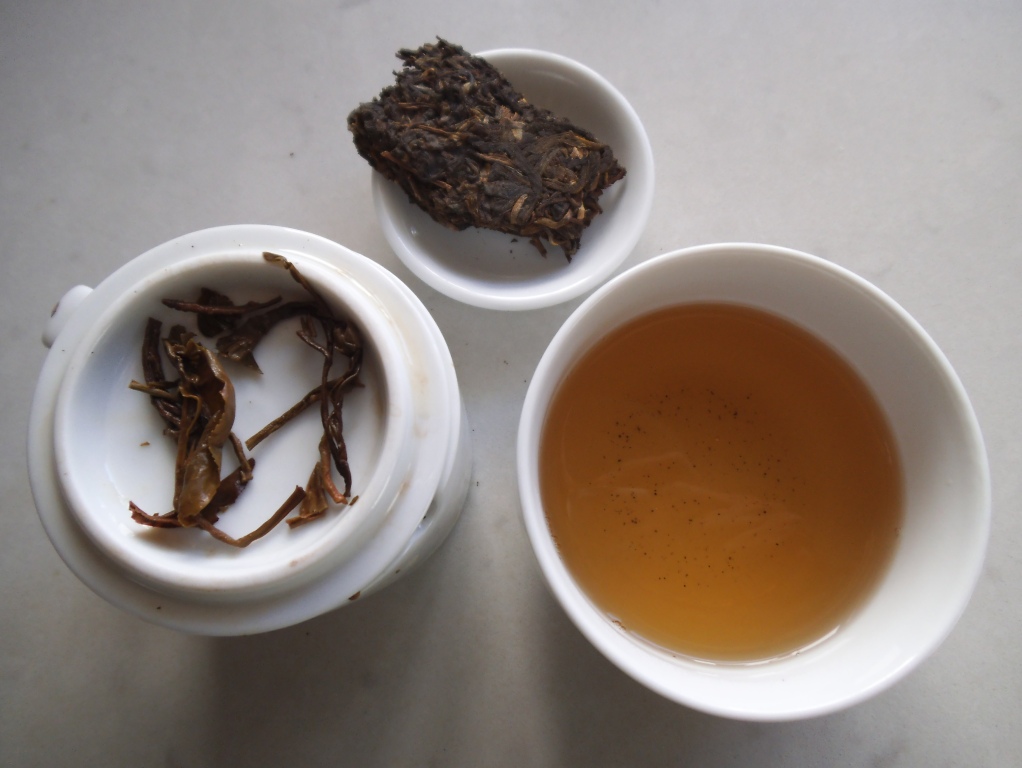
Dry Leaf:  The leaves are dark brown, medium-sized and twisted. They have layers of aromas: exotic guavas, burning coals, herbal spices and white flowers.
Wet Leaf:  The dark brown leaves are toasty and slightly peppery.
Liquor:      The orange amber tea is toasty and chocolaty.  It is faintly sweet, fruity and herbaceous.  Its mouth feel is dry.

Tee Score: 4 out of 5

Saturday, April 30, 2016

Medium-Fired High Mountain Oolong

The purpose of firing or baking at the final stage of tea processing is to improve or enhance the aromas and flavors of tea.   Firing is not meant for all teas but it works wonderfully for some oolong teas.   After oolong leaves have been rolled and shaped, they are quickly dried to remove extra moisture as well as to retain shape.   Depending on the desired outcome of a oolong, an experienced and skilled tea master will determine if firing is required and the temperatures and times of the firing step.   Traditionally, tea is placed in giant bamboo baskets, underneath which charcoal heat source is applied over a long period of time.   Contemporarily, alternative heat source (e.g., wood and electricity) and equipment are popular.   For example,  below is a small commercial tea baking oven available on the market:

tea baking oven

This medium-fired oolong is made from Qing Xin (green heart) cultivar grown at 3600 feet in Meishan area, southwest of Luku, in Taiwan.  It went through three-step slow firing.   It is more complex and richer than a 'green' type of oolong, and is best enjoyed using a multiple-infusion method to appreciate the depth and layers of the tea.  

Medium-fired oolong

Type:  Oolong   Producing Country: Taiwan   Preparation:  90°C 5 Min

Dry Leaf:  These nice beads are clean, sweet and slightly toasty.   Hardly any stems are found.
Wet Leaf:  The wet leaves are seductively sweet and aromatic.
Liquor:     A 5-minute, 2 g and 4 oz cupping produces an orange color liquor that is smooth, fragrant, sweet and floral.   When steeped a la Gong Fu, the first infusion is nutty or honey-nuttty.  The next infusion is about sweet honey and flowers.  The last infusion includes nice notes of orchid and wood.

Tee Score: 5 out of 5

Thursday, March 24, 2016

Ethnic Group Pu'er Teas

Xishuangbana Mengyang Guoyan Tea Factory in Yunnan, China, produced sets of ethnic minority pu'er cakes in 2004/5 and 2006/7.   Each set contains four cakes, representing four ethnic groups (Hani, Bulang, Jinuo and Dai), the tea trees grown around the areas they reside, and their pu'er processes.  There are at least twenty-five minority groups in Yunnan and the majority of them have very rich tea cultures.

  • Hani ethnic group: High Mountain Cloud Mist cake from early spring tea leaves picked from Nan Nuo Mountain
Hani High Mountain Cloud Misty Pu'er

  • Bulang ethnic group: Organic Ecology cake from tea leaves grown by Bulang people on Bulang Mountain
Bulang Organic Ecology Pu'er

  • Jinuo ethnic group: Longpa Ancient Arbor cake from Youle Mountain Longpa Ancient Tea Garden's tea leaves
Jinuo Longpa Ancient Arbor Pu'er

  • Dai ethnic group: Daughter's Tribute cake with leaves picked by single young Dai girls.   
Dai Daughter's Tribute Pu'er

A comparative tasting of the 2004/2005 sample teas, Yunnan storage, is below. Methodology: 2 g leaves, 100ml water, 100C, one rinse and 5-minute brewing time.

Minority
Liquor
Leaves
Tasting
Hani
Golden amber
Leaves a bit smaller than Bulang’s and more compressed
Medium body, citrusy, plummy, sweet, some astringency
Bulang
Golden amber orange
Larger leaves
Thick, woody, licorice bitter sweet, spicy and lengthy in the mouth
Jinuo
Amber orange
Some buds and more chopped younger leaves
Medium to light body, wet rattanish, smooth but not complex
Dai
Light brown
More whole younger leaves
Medium body, sweet, mellow with a light sandalwood/incense aroma


Friday, February 19, 2016

Pomelo Flower Scented Teas

Pomelo or Shaddock is a citrus fruit native to Asia.  It looks very much like an over-sized grapefruit but is less acidic.   The flesh can be white or pink.  As for the blossoms of pomelo trees, they are white, showy and fragrant.   The very sweet-smelling flowers are used in some perfumes.

Pomelo

To produce scented teas, the tea farmers mix fresh pomelo flowers with tea leaves before removing them to further process the teas.   The following two teas are scented with these aromatic pomelo flowers.

The first impression of a pomelo flower scented Four Season oolong is a nice jasmine-like green tea.  The pomelo flowers add a citrus floral note to this Taiwanese oolong and enhance its greenness.  

Pomelo flower scented Four Season oolong

 Type:  Oolong  Producing Country: Taiwan   Preparation:  90°C 5 Min

Dry Leaf:  The small semi-ball leaves of Four Season are floral (white flowers and orchid) and citrusy.
Wet Leaf:  The wet leaves are green floral.
Liquor:   It is a straw color tea that opens with citrus and orchid notes, and gradually fades into a regular green oolong scent.  It is light and refreshing.

Tee Score: 4 of 5

**********************************************************

Taiwanese Red Jade is a flavorful black tea.  Pomelo flowers elevate it to an exotic black tea that is rich, lush and complex.   It is ideal for multiple infusions.
               
Pomelo flower scented Black tea
Type:  Black    Producing Country: Taiwan    Preparation:  95°C 4 Min

Dry Leaf:  The long twisted leaves are a sweet bouquet of magnolia, freesia, plumeria and orange blossoms.
Wet Leaf:  The wet leaves are aromatic:  malty, floral and citrusy.
Liquor:   The color of the tea is rich-brown.  The liquor has light astringency but is fairly malty sweet.  The floral and citrus opulence lingers long in the mouth, and sometimes it feels like having jujubes or jam.

Tee Score: 5 of 5

Wednesday, January 27, 2016

Yun Hong Black Tea

In the Wenshan District of Taipei, Taiwan, Muzha Tie Guan Yin and Wenshan Baozhong are two well-known oolong teas produced there.   Both fine oolongs are crafted from the tea leaves plucked in the spring or winter.  The local tea farmers normally forgo picking leaves in the summer and autumn because they consider the leaves from these two seasons to be too astringent to make quality oolongs.   But Taipei Farmers Association recently began to experiment with as well as to encourage the production of black teas from the summer and autumn leaves.  The payoffs are two new black teas:  Yun Hong (Rhythm Red from Chin Shin and small-leaf cultivars) and Tie Yun Hong (Iron Rhythm Red from Iron Goddess cultivar)

Taipei Tea Research, Development and Promotional Centre for Tieguanyin and Baozhong 

Small baking tools for Iron Goddess and Yun Hong

Yun Hong means Rhythm Red and is the inversion of Hong Yun (Red Rhythm). Yun Hong is not Hong Yun, which is from TRES 21 cultivar grown in Yuchi, Taiwan.

2015 Muzha black tea competition silver category seal

Silver category Yun Hong tea canisters 

This 2015 Yun Hong was created from the leaves of Chin Shin and other available small-leaf tea cultivars in the Wenshan District, Taipei.  It is marketed by Taipei Farmers Association.   It is a medium-bodied black tea.  It is smooth, simple and not spectacular.


Type:  Black    Producing Country: Taiwan    Preparation:  95°C 4 Min

Dry Leaf:  The small and medium twisted leaves are black.  They have a nice biscuit or malty aroma.
Wet Leaf:  The wet leaves have a barely detectable floral scent.
Liquor:   The tea is amber brown.  The liquor smells malty.  It is slightly sweet and medium-bodied.   It lacks astringency and is smooth.  

Tee Score: 4 of 5

Monday, December 28, 2015

Meng Ding Gan Lu

Meng Ding Gan Lu hails from Sichuan Province, where giant pandas roar. Sichuan is reputed to be the birth place of cultivated teas and Meng Ding Gan Lu one of the oldest Chinese green teas.

Meng Ding Gan Lu is a green tea from Meng Ding Mountain in Sichuan, China.   Gan Lu means sweet dew and may trace its name back to a Taoist master Wu Lizhen, with the posthumous title of Master of Ganlu, who first planted seven tea bushes on Meng Ding Mountain around 53 BC.

The making of Gan Lu is more labour-intensive: rolling and wok drying are repeated three times to achieve a delicate tea bouquet.  Although Gan Lu is refreshing and delightful, it is a lot like other premium Chinese green teas.  However, it is special for its historical significance.

Meng Ding Gan Lu

Type:  Green   Producing Country: China     Preparation:  80°C 3 Min

Dry Leaf:  The tippy leaves are tiny, olive green, curly and wiry.  Their appearance is delicate, and their fragrance is a mix of straws and dried mushrooms.
Wet Leaf:  Most of the leaf sets include a bud and one to two tiny leaves. The aroma is on the vegetal side - umami cooked green beans.
Liquor:   The tea is pale yellow in color.  It is airy and mellow, and tastes vegetal and chestnut sweet.

Tee Score: 4 of 5

Sunday, December 27, 2015

Japanese White Tea

A few Japanese tea farmers have begun venturing into limited white tea production.  This Kanayamidori white tea is from Gokase, Nishiusuki district of Miyazaki Perfecture in Kyushu.   Kanayamidori is a Japanese tea cultivar resulted from the hybridization of Yabukita, the most popular tea cultivar in Japan, and Zairai.

The leaves of Kanayamidori are smaller than those of Yabukita but they can produce a sencha with body and aroma.  As for this white tea from the said cultivar, it is quite impressive.   The tea contains no buds but healthy young-looking whole leaves plucked by hand.   Mellow and sweet are the words to describe this Japanese white tea.

Kanayamidori white tea

Type:  White    Producing Country: Japan     Preparation:  85°C 4 Min

Dry Leaf:  The leaves are dark green or brown with some oxidation.  Their scent is fresh and mildly spicy like cinnamon and anise.
Wet Leaf:  The tender wet leaves smell similar to wet hay and green beans.   Spiciness is also present.
Liquor:   The tea is orange yellow.  It is mild, light and sweet.  In addition, it is herbaceous or spicy (cinnamon, clove and chrysanthemum flower).

Tee Score: 4 of 5