Monday, December 28, 2015

Meng Ding Gan Lu

Meng Ding Gan Lu hails from Sichuan Province, where giant pandas roar. Sichuan is reputed to be the birth place of cultivated teas and Meng Ding Gan Lu one of the oldest Chinese green teas.

Meng Ding Gan Lu is a green tea from Meng Ding Mountain in Sichuan, China.   Gan Lu means sweet dew and may trace its name back to a Taoist master Wu Lizhen, with the posthumous title of Master of Ganlu, who first planted seven tea bushes on Meng Ding Mountain around 53 BC.

The making of Gan Lu is more labour-intensive: rolling and wok drying are repeated three times to achieve a delicate tea bouquet.  Although Gan Lu is refreshing and delightful, it is a lot like other premium Chinese green teas.  However, it is special for its historical significance.

Meng Ding Gan Lu

Type:  Green   Producing Country: China     Preparation:  80°C 3 Min

Dry Leaf:  The tippy leaves are tiny, olive green, curly and wiry.  Their appearance is delicate, and their fragrance is a mix of straws and dried mushrooms.
Wet Leaf:  Most of the leaf sets include a bud and one to two tiny leaves. The aroma is on the vegetal side - umami cooked green beans.
Liquor:   The tea is pale yellow in color.  It is airy and mellow, and tastes vegetal and chestnut sweet.

Tee Score: 4 of 5

Sunday, December 27, 2015

Japanese White Tea

A few Japanese tea farmers have begun venturing into limited white tea production.  This Kanayamidori white tea is from Gokase, Nishiusuki district of Miyazaki Perfecture in Kyushu.   Kanayamidori is a Japanese tea cultivar resulted from the hybridization of Yabukita, the most popular tea cultivar in Japan, and Zairai.

The leaves of Kanayamidori are smaller than those of Yabukita but they can produce a sencha with body and aroma.  As for this white tea from the said cultivar, it is quite impressive.   The tea contains no buds but healthy young-looking whole leaves plucked by hand.   Mellow and sweet are the words to describe this Japanese white tea.

Kanayamidori white tea

Type:  White    Producing Country: Japan     Preparation:  85°C 4 Min

Dry Leaf:  The leaves are dark green or brown with some oxidation.  Their scent is fresh and mildly spicy like cinnamon and anise.
Wet Leaf:  The tender wet leaves smell similar to wet hay and green beans.   Spiciness is also present.
Liquor:   The tea is orange yellow.  It is mild, light and sweet.  In addition, it is herbaceous or spicy (cinnamon, clove and chrysanthemum flower).

Tee Score: 4 of 5

Wednesday, November 25, 2015

Bubble Tea

"Shaken, not stirred" is how 007 James Bond likes his martini made. 'Shaken, and stirred' is how Chun Shui Tang (Spring Water place) prepares its pearl milk tea.

Chun Shui Tang is credited with the creation of bubble tea (a.k.a. pearl milk tea or boba tea) in Taiwan.   Mr. Liu Han-Jah established Chun Shui Tang in Taichung, Taiwan, in 1983, and later came up with the idea of offering his customers 'foamy iced black tea' using a cocktail shaker.  In 1987 Ms. Lin Hsiu-Fui, one of Mr. Liu's employees, made a whimsical choice to put her favorite Taiwanese tapioca balls (fen-yuan) in her iced tea, and subsequently started to share her concoction with her colleagues and customers.  Before long, the tapioca ball milk tea became an instant success and the rest is history.  

Bubble teas are made to order at Chun Shui Tang.  Customers may choose the amount of ice and sugar in their drinks.   The proximate steps for making its famous pearl milk tea are as follows :

- put ice in a cocktail shaker
- add 80 cc brewed Assam black tea
- stir in creamer and cane sugar syrup
- **add cooked tapioca balls (7 mm size)
- shake 33 times
- pour and serve in a coffee glass mug or a tall paper cup.
** alternatively, put cooked tapioca balls in a glass or a cup then pour shaken milk tea over them.  Stir the tea lightly with a straw.

The characteristics of good bubble teas are foamy on top, fresh tea aromas, not too sweet and 'al dente' tapioca pearls.

Pearl Milk tea in the patio of Chun Shui Tang

foamy pearl milk tea

7mm tapioca balls

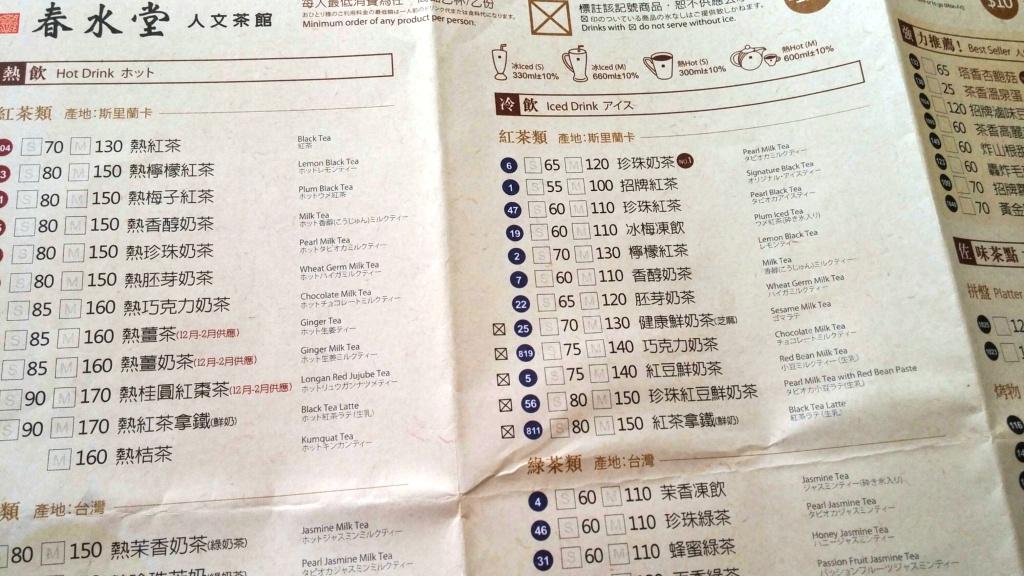
The original Chun Shui Tang is located in Siwei Street, Taichung, and was renovated in 2014.  Below are photos of  menu and Yongfu Road store in Taichung, which is five miles west of the flagship tea house.  As of 2015, there are about 42 Chun Shui Tang tea houses in Taiwan and five in Japan.   The tea houses serve a variety of cold and hot beverages as well as food.


Yongfu Road Chun Shui Tang

Tuesday, October 20, 2015

London Fog

The word on the street is that London Fog was created in Vancouver, British Columbia, Canada, around mid 2000.   However, if you ask people on the streets of Vancouver about the origin of this drink, you would get a blank look.  So far, no one has claimed credit for this hot beverage.

London Fog, in essence, is an Earl Grey tea latte.   Commonly, to make a London Fog drink, use two thirds Earl Grey brewed tea and add one third steamed milk plus a shot of vanilla syrup.   There are many variations of London Fog depending on whom, where, what and how.   Below are four Vancouver samples of London Fog:

Blenz Coffee on Commercial & Broadway
lemony, citrusy, no tea taste, not too sweet and no foam.


Murchie's at Oakridge Shopping
More tea taste, barely sweet and two tea bags floating in the foam.  


Starbucks on Commercial and Broadway
one tea bag, foamy, lemony and a bit too sweet


Sweet Revenge on Main
Tea leaves used, more refined vanilla and citrus flavors.


Monday, September 28, 2015

Sparrow's Mouth

This 'thingy' is sold as white tea or Pu'er tea from Yunnan, China.  It has several names, including Yabao and Nan Mei.  

The buds are picked and then sun-dried or steamed & sun-dried.   Some are further compressed into round cakes.  The buds do not resemble any regular white tea leaves (e.g., silver needles) and have a piney aroma.

Sparrow's Mouth

Use boiling water to brew and re-brew the buds for making 'tea'.   The infusion is mild, sweet, floral and lightly spicy.   A pleasant piney and sweet aftertaste lingers in the mouth.

Sparrow's Mouth infusion

Is it or is it not?  This wild 'thingy' is not a true tea but is likely from the buds of wild-grown vaccinium dunalianum var dunalianum in Yunnan. Local Chinese people call it Sparrow's Mouth.  Limited analysis of it has shown that Sparrow's Mouth contains no caffeine.  There are two types of Sparrow's Mouth : purple and white.   Both are touted as remedies for detoxification, indigestion, sore throat, lethargy, high cholesterol and high blood pressure.   The 'thingy' is also known as Moonlight Goddess because the steeped buds could appear like ladies in a hot tub!     

Moonlight Goddess

Monday, August 24, 2015

Snow Chrysanthemum

Snow chrysanthemum belongs to the sanvitalia procumbens plant species and grows in high elevations around the Kunlun Mountain in China's Xianjian province.   Infusions made from the dried blossoms of snow chrysanthemum have been enjoyed by the ethnic Uighur people in China.

Snow chrysanthemum is touted as containing large amounts of health-promoting amino acids and trace elements.   Wild harvested flowers are scarce and would command a higher price.  Consequently, many farmers began to cultivate the plant for lucrative profits.  This eventually led snow chrysanthemum to become a commodity of speculation and manipulation in recent years.   The price of snow chrysanthemum per kg climbed up to $3000 USD in 2011.   Then, thump, it crashed down to $5 USD per kg in 2012.    It was a story of rags to riches and back again.


Snow chrysanthemum brew is orange crimson color.  It has herbal, creamy and mild berry flavors.   It can be brewed alone or added to regular teas.

Wednesday, July 29, 2015

Savory Teas

A savory tea is a melange of vegetables, herbs, spices and tea.   Numi produces 6 blends of interesting savory teas:  Carrot Curry, Fennel Spice, Spinach Chive, Tomato Mint, Beet Cabbage, and Broccoli Cilantro.   Following are four of the six blends.  They all contain decaffeinated green or black teas.

Savory teas

To make a cup or a bowl of savory tea, brew one tea bag in hot water for over 10 minutes.  What are the infusions like?  They come close to salt-free vegetable broths.   Take Fennel Spice for example, it has a strong flavor of fennel and no hints of green tea.  As for Tomato Mint, it is zesty, minty and spicy.  

The ingredients in Fennel Spice are organic fennel, organic celery root, organic orange peel, organic onion, organic dill, organic decaf green tea, organic honeybush and organic black pepper.   The ingredients in Tomato Mint are organic tomato, organic onion, organic mint, organic lemon peel, organic parsley, organic cinnamon, organic black pepper, organic decaf black tea, and organic allspice.    

Fennel Spice and Tomato Mint